Post-Patriarchal Therapy
Power, Meaning, and the Myth of Clinical Neutrality

Read this and other articles on the Bright Insight Blog @ www.brightinsight.support/blog
IMPORTANT UPDATE AND APOLOGY
This piece began as an argument for “decolonizing therapy.” Then someone more deeply in the know and the reality of this topic shared Tuck and Yang’s Decolonization Is Not a Metaphor with me, and I realized I needed to stop and rethink what I was actually doing with that language. Their work made something uncomfortably clear: decolonization names a specific political and material struggle, not a metaphor for professional or conceptual reform.
In talking this through, I learned that most non-Indigenous writers who take decolonization seriously name two realities at once: their ongoing presence on colonized land, and the fact that there is no decolonization without “land back” — the return of land to the people who belong to it, with all its real consequences. This includes recognizing that tribal nations are already engaged in material decolonization. It also requires honesty about where threat is felt: not in the return of Indigenous land to Indigenous people, but in the current structures of power. Reversing that sense of threat reverses the logic of colonization. For me, that means understanding alliance with this political and material struggle, as a white U.S. citizen, as an ethical orientation rather than a metaphor.
I did not hold that line clearly enough. Taking that orientation seriously opens not just critique but possibility, including different ways of organizing care and authority and the presence of matriarchal and relational systems that do not translate difference into defect. That horizon belongs with Indigenous sovereignty and material decolonization, not as metaphor. I used “decolonization” to name harm in Western systems, including therapy, because I see land colonization as an attitude. It is the belief that one can take, define, dominate, and decide, and it appears in land grabs, patriarchy, and institutional authority. That same logic has shaped therapy and other institutions, which is what I was trying to name.
What became clear when I slowed down and listened is that what I was also describing was patriarchal logic: hierarchical authority over meaning, the privileging of certain ways of knowing, and the translation of difference into defect. The argument itself did not change. The responsibility of the language did. So this piece is now about post-patriarchal therapy instead.
This is where the tension lives for me, though. I worry that shifting entirely to the language of patriarchy risks letting some people off the hook, especially those who see themselves as “good white people” or feminist, or liberals, or those who are trying to get it right, while still participating in the same hierarchical logic. And at the same time, I do not want to commandeer a term that does not belong to me in earnest. I was trying to name real harm. And intent does not cancel impact.
So, I also want to name the struggle underneath this revision. I reacted quickly because I did not want to “get it wrong.” That response is part of whiteness at work: the rush to be a good ally can become ego-centered rather than centering the people and struggles that matter most. “Honest and good” does not fix anything if it still allows me to behave badly. This fragility, the fear of misstepping, is one of the reasons so many White people freeze instead of acting when they know something is wrong. Worrying about being wrong can become another way of avoiding the actual work.
This revision is part of that work. And so is this apology.
Post‑Patriarchal Therapy: Power, Meaning, and the Myth of Clinical Neutrality
Modern psychotherapy often presents itself as neutral, benevolent, and scientific. It treats distress as an individual flaw, legible through diagnostic categories and correctable through expert intervention. That neutrality is persuasive, and it is also historically inaccurate. Psychotherapy did not emerge in a vacuum. It developed inside patriarchal, hierarchical, and institutional systems built to classify, regulate, and normalize human behavior. Those origins still shape the therapist–client relationship through implicit hierarchies of authority, meaning-making, and legitimacy. As such, moving beyond patriarchy does not belong only in politics or education. It belongs in the therapy room.
When I talk about post‑patriarchal therapy, I am not talking about swapping one dominant model for another. I am talking about dismantling the assumption that any single system should hold supremacy over human meaning. That requires confronting the therapist–client hierarchy as a power structure, not just a technical arrangement.
This is not, at its core, a question of technique or modality. It is a question of authorship. Who gets to decide what a person’s experience means? That question is not small.
Patriarchal Logic as Clinical Form
Patriarchal systems organized the world through binary roles: knower and known, rational and emotional, authoritative and subordinate, expert and dependent. Psychiatry inherited this logic. The clinician observes, names, and corrects. The patient is observed, classified, and treated. Even when care is compassionate, the structure remains asymmetrical. This hierarchy is reinforced in academia; another patriarchal space where authority is mistaken for objectivity. Within this system, the therapist is positioned as a neutral judge and jury, rather than as a participant in a relational process of meaning-making.
And historically, diagnostic categories tracked social power. “Hysteria” pathologized women’s resistance to constraint. “Drapetomania” framed enslaved people’s desire for freedom as illness. Schizophrenia became racialized as Black men began to be diagnosed in disproportionate numbers during the civil rights era. Though not always placed with malice, these were not scientific errors. They were political translations of threat into pathology.
That same pattern continues in contemporary form. Autistic and AuDHD people, especially women and people of color, are routinely misdiagnosed as bipolar, borderline, or psychotic when what is actually being observed is sensory overload, nonlinear cognition, trauma history, or emotional intensity. Neurodivergent regulation strategies are read as mood instability. Moral distress is read as disorder. Context is stripped away and replaced with a label that makes the person legible to the system rather than to themselves.
What is often an ecologically appropriate stress response or a form of positive maladjustment is cast as pathology. When people push back against this translation, that resistance itself is labeled evidence of deeper instability and illness.
What gets called “objectivity” has always carried hidden judgments about what kinds of behavior were tolerable, whose distress was legitimate, and whose coherence counted as rational. Therapy became a translation device that converted social and relational injury into individual disorder.
This logic persists in subtler forms—blatant to some.
The therapist is trained to interpret.
The client is trained to comply.
Meaning flows upward.
Authority flows downward.
The Therapist–Client Hierarchy as Epistemic Structure
The standard clinical relationship rests on three assumptions:
The therapist knows how to interpret experience.
The client’s account is distorted by symptoms.
Correct understanding produces improvement.
This creates a hierarchy of credibility, where the power to define meaning reinforces professional authority. The therapist’s conceptual framework is treated as primary. The client’s lived coherence is filtered through diagnostic and theoretical lenses. Even collaborative models often preserve the therapist’s interpretive veto power. This arrangement reproduces patriarchal epistemology: interpreter over subject, authority over voice, theory over life.
Epistemic injustice occurs when people are not treated as credible narrators of their own experience. In therapy, this happens when distress is re-coded into categories that remove its social, political, and relational intelligibility. A person is no longer responding to a world. They are expressing a disorder.
From this position, “insight” becomes agreement with the therapist’s frame. “Resistance” becomes refusal of translation. Healing becomes compliance with externally authored meaning. And a lack of movement gets placed on the client as the failed party, since, after all, they were flawed to begin with.
Political Neutrality as Myth
It is also important for me to assert here that therapy is not politically neutral. It operates inside legal systems, insurance structures, diagnostic regimes, and professional hierarchies. These institutions reflect dominant values about productivity, emotional regulation, family structure, and what counts as acceptable difference. They also reward silence and emotional neutrality when suffering falls outside what clinicians have been trained to recognize. The “blank slate” is treated as professional virtue even when it functions as distance from realities that do not resemble the therapist’s own.
When therapy locates suffering solely inside the individual, it participates in depoliticization. Structural violence becomes private dysfunction. Racism becomes anxiety. Exploitation becomes depression. Gaslighting becomes a cognitive distortion. Context disappears. And experiences that do not fit what was modeled in graduate school or dominant culture are dismissed as overreaction, cognitive distortion, or irrational belief. What is being protected in those moments is not the client. It is the framework.
This alignment does not require malicious intent. It requires only that therapy maintain loyalty to a medicalized worldview that prioritizes manageability over meaning and stability over truth. Neutrality, in this sense, becomes a political position: one that preserves existing norms while misrecognizing their effects.
A post‑patriarchal therapy does not abandon rigor. It refuses innocence. It recognizes that interpretation is never neutral, that silence is never empty, and that whose suffering is taken seriously is always shaped by power.
Language as a Tool of Patriarchal Control
Diagnostic language functions as a border patrol for experience. It decides what counts as real, what counts as rational, and what requires correction.
“Maladaptive.” “Irrational.” “Disordered.”
These terms imply deviation from a presumed norm. That norm is barely named, though it is implicitly linear, emotionally restrained, productivity-oriented, and authority-compliant. It reflects a particular way of surviving and organizing life and then universalizes itself as health.
In contrast, many experiences labeled pathological are intelligible adaptations. Hypervigilance can be understood as safety intelligence, dissociation as a containment strategy, emotional intensity as moral attunement, and nonlinear cognition as pattern detection. There is wisdom in these adjustments. They arise from real conditions and real histories. They solve real problems. However, when therapy insists on “symptom reduction” without relational or historical analysis, it performs symbolic erasure. Political injury is translated into a supposed chemical imbalance, relational betrayal becomes faulty perception, and developmental struggle becomes dysfunction. What was once a meaningful adaptation is reframed as error.
Language does not merely describe this shift; it enforces it. Diagnostic tools and DSM codes become instruments of authority, deciding which meanings are legitimate and which must be corrected. In this way, clinical language does not just name distress; it organizes power. I learned this the hard way, when being able to “get it right” with a diagnosis felt like competence and clarity. What it also did was center the framework and my ego over the person.
Post‑patriarchal therapy requires treating language as an ethical act rather than a neutral tool, and treating meaning as something negotiated with the person who lives it rather than imposed from outside their experience. We need language that communicates and co‑creates understanding, rather than language that enforces status, compliance, or control.
Relational Epistemology of Co‑Constructed Meaning
Relational epistemology holds that knowledge is generated through relationship, not delivered from above. Meaning emerges through dialogue, not diagnosis. Understanding is negotiated, not imposed. This is why real change in therapy rarely follows a straight line. A session can feel stuck until a single moment of real attunement shifts the whole emotional field. What changes is not a symptom in isolation—it’s the organization of the whole system.
Seen this way, therapeutic change is relational and autopoetically self‑organizing, where small shifts in safety or meaning can reorganize an inner world. This is why many hyperneuroplastic and neurodivergent clients do not benefit from more explanation layered onto their experience. They benefit from environments that support self‑directed value reconstruction under conditions of safety and coherence. From this view, autopsychotherapy is a stance within therapy: an orientation toward accompaniment and self‑authored growth rather than linear correction.
In a post‑patriarchal therapeutic relationship, the client remains the primary authority on meaning. The therapist is accountable for interpretive power. Theory is disclosed rather than silently applied. Interpretation requires consent. Disagreement is not pathology. And so importantly, this process relocates expertise. The therapist becomes a skilled companion in inquiry rather than an arbiter of truth.
Therapy becomes a space of shared sense‑making rather than corrective translation.
Dąbrowskian Dynamism and the Misreading of Distress
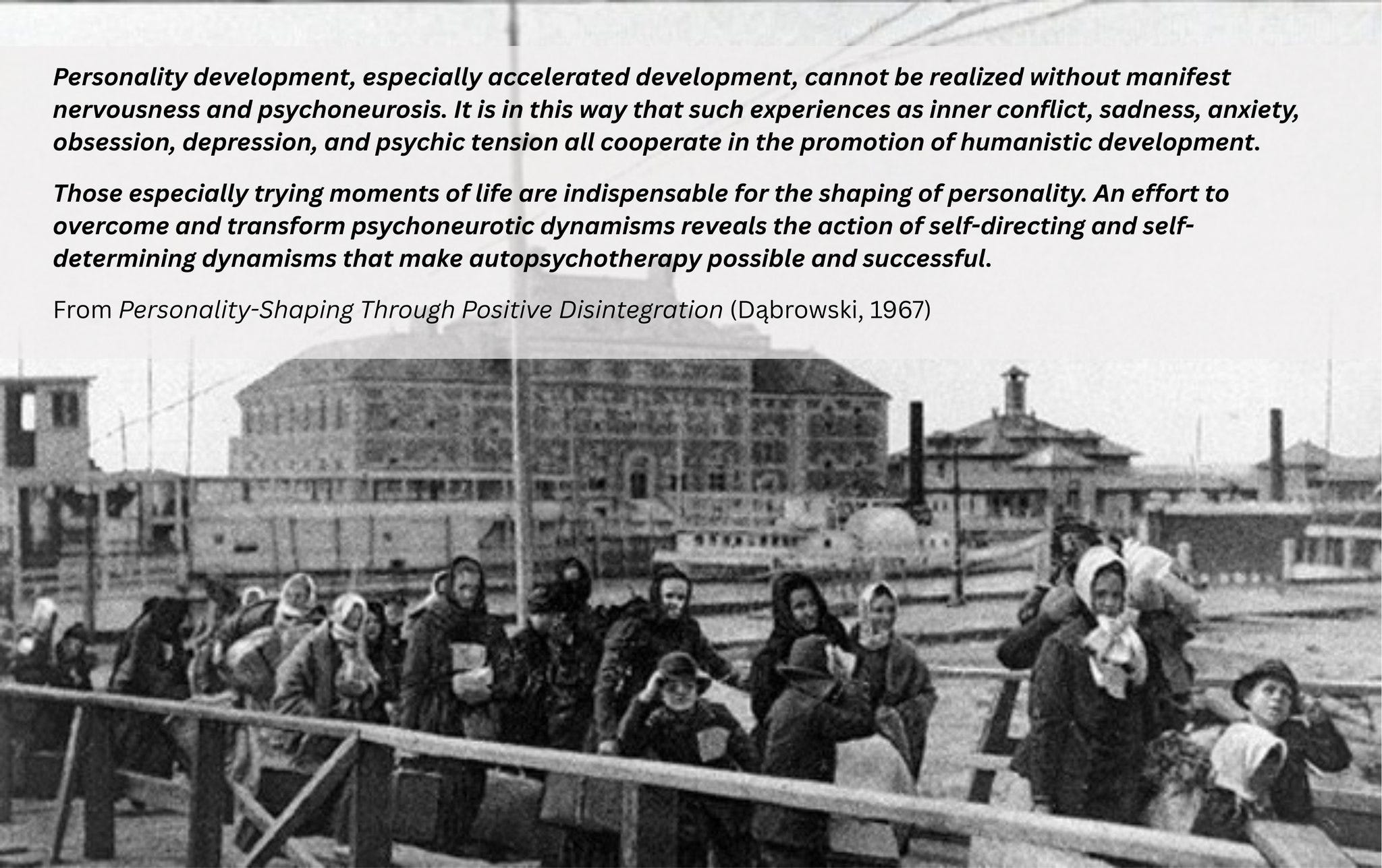
Dąbrowski’s Theory of Positive Disintegration offers a direct challenge to patriarchal pathologizing. Dynamisms describe inner forces that drive development through conflict, valuation, and reorganization. Suffering, through a Dąbrowskian lens, is often a signal of moral and existential differentiation rather than merely a symptom. From this perspective, anxiety can reflect heightened ethical awareness, depression can signal value incongruence, inner conflict can indicate developmental movement, and emotional intensity can be fuel for restructuring.
Patriarchal therapy reads distress as dysfunction. A dynamistic view reads distress as movement. One asks how to eliminate it. The other asks what it is organizing. And Dąbrowski explicitly rejected the idea that mental health meant stability or adaptation to existing structures. Instead, he defined it in terms of the capacity to loosen rigid psychological organization in service of higher values:
Mental health would, thus, presume the ability to ‘loosen’ and even ‘break’ one’s own primitive, narrow, and rigid mental structure. It would presume the capacity for positive disintegration and secondary integration through transgression of the biological life cycle and of one’s own psychological type. This, in turn, would be linked with the development of a higher level of inner psychic milieu and its main dynamisms. Thus, it would be also linked with the autonomous and authentic needs of a clear realization of the personality ideal. (Dąbrowski, 1973, p. 176)
This view stands in direct opposition to patriarchal models of care that treat disruption as failure rather than as the possible beginning of autonomy, conscience, and self‑authored meaning. It also reframes treatment from normalization to development, it preserves the client’s internal authority, and it honors meaning as emergent rather than prescribed.
Autopsychotherapy and Non‑Hierarchical Practice
Autopsychotherapy, another Dąbrowskian term and dynamism, treats the individual as the primary agent of their own psychological work. Support exists to clarify and accompany, not to replace internal sense‑making. This is not radical individualism; it is epistemic sovereignty.
In practice, this means insight is generated internally rather than implanted. The therapist supports pattern recognition instead of supplying conclusions, and change arises from coherence rather than compliance. The client’s internal logic and wisdom, that is, is assumed meaningful. They are believed in their experience. Autopsychotherapy resists patriarchal hierarchy by refusing to outsource meaning and restoring authorship of inner life. A post‑patriarchal therapist does not diagnose a person’s reality; they help the person engage with it.
Non‑hierarchical therapy follows the same logic: it engages with epistemic humility, transparency about theory, consent‑based interpretation, and contextualization. Power does not vanish; it becomes visible and accountable. And so this process does not abandon structure. It simply refuses unexamined authority. Therapists still hold institutional, legal, and cultural power, and naming that power prevents covert domination. A disciplined, post‑patriarchal practice avoids both coercion and romanticizing suffering by treating distress as intelligible while remaining developmentally and ethically grounded in honest integrity.
From Authority to Accountability
The need for post‑patriarchal therapy shows up in racialized trauma, gendered diagnosis, neurodivergent misattunement, chronic misdiagnosis, the medicalization of grief and moral injury, the pathologizing of intense inner lives, and the routine dismissal of social and economic harm as individual dysfunction. It also appears in how those labeled “resistant” are often protecting themselves from being translated out of their own experience while still seeking support. People are not asking for less care; they are asking to be recognized.
Post‑patriarchal therapy is not a trend. It is a reckoning with the politics of interpretation.
Patriarchal therapy assumes that meaning should be delivered by the so‑named expert. Post‑patriarchal therapy begins from the opposite premise: meaning must be discovered by the person living it.
Though it may look technical, this is an ethical shift from interpretation to dialogue, from hierarchy to relational authority, from symptom to coherence, and from control to development.
Therapy does not need to become less skilled. It needs to relinquish unilateral authority over meaning and over the direction of change. This does not make therapy passive. It makes it answerable and honest.
We are not shaping people into a predefined version of health. We are not translating their lives into categories and calling that care. We are working with living systems that already have direction, values, and wisdom. The task of therapy, in this frame, is not to author those paths. Post‑patriarchal therapists and helpers accompany humans on their paths while helping them understand their own ways of knowing where they go.

The revision at the beginning says a lot about the seriousness of this project. Slowing down, reconsidering language, and being explicit about power rather than just intent strengthens the argument rather than weakening it.
The throughline about authorship feels central. Who decides what distress means is not a technical question, it is a political one. The critique of neutrality as a posture that protects existing frameworks is especially sharp.
I also appreciate the way you distinguish between abandoning rigor and relinquishing unilateral authority. That distinction matters if this is going to be more than rhetoric. The Dąbrowskian frame gives the piece developmental weight, not just critique.
This piece realy made me reflect on how language evolves, almost like debugging a tricky piece of code in your mind. It makes me wonder how much more meaningful our actions become when we truly grasp the underlying truth?