
Gestalt Processing, Hyperneuroplasticity, and a New Research Question
GLP as Neurotendency

Some children learn to say “want to go bye-bye” before they understand what any of those words mean alone.
Some people can quote a film with exact intonation, exact affect, exact breath, and use that quote, precisely, when something in the moment calls for it.
There are even people who memorized entire books before they could read analytically, who knew what the words felt like before they knew what the words were.
I have been well aware of GLP for quite some time. I am dyslexic. I read and process with what I think of as all-sided whole-sightedness: meaning arrives as a complete shape, often before I have access to its parts. I am a gestalt processor. When I read the GLP literature, I am reading a description of my own nervous system. So this isn’t an outside theory for me. It’s me, asking what produced me.
What Is Gestalt Language Processing?
Gestalt Language Processing, or GLP, describes a top-down route into language. The conventional model builds upward such that sounds become words, words become phrases, and phrases group into sentences. GLP starts at the other end. A chunk of language arrives first as a whole, emotionally engaged and tied to a specific context. The speaker stores it, uses it, and later begins to break it apart and recombine the pieces.
The idea of gestalt processing traces back to Barry Prizant’s work on echolalia in the early 1980s, later developed clinically by Marge Blanc in her 2012 framework, Natural Language Acquisition on the Autism Spectrum. Right now it’s a contested construct. Haydock and colleagues (2024), in Autism, argue that GLP should be recognized as a legitimate developmental trajectory. Hutchins and colleagues (2024), in Autism & Developmental Language Impairments, push back hard. “Gestalt language processor” lacks a clear definition, they argue, and the widely repeated claim that 75–85% of autistic children are GLPs is difficult to quantify. The field, in their view, adopted the label before solidifying the mechanistic work underneath it.
That’s a fair question to raise. And it leaves something out: how do we account for the lived experience of gestalt processing? I know this reality is felt by so many HNP-profile people, whatever the prevalence numbers turn out to be.
I think hyperneuroplasticity can answer it.
GLP, seen through a hyperneuroplasticity (HNP) lens, is a neurotendency; and I mean that word deliberately. Not a neurotype, with all the fixed, diagnostic weight that word can carry. A neurotendency. Something a nervous system leans toward, more or less, depending on conditions, rather than something a person simply is. The real question isn’t “is this person a gestalt processor.” It’s how strongly, and under what conditions, a given nervous system’s neurotendency expresses toward whole-unit, meaning-first language acquisition.
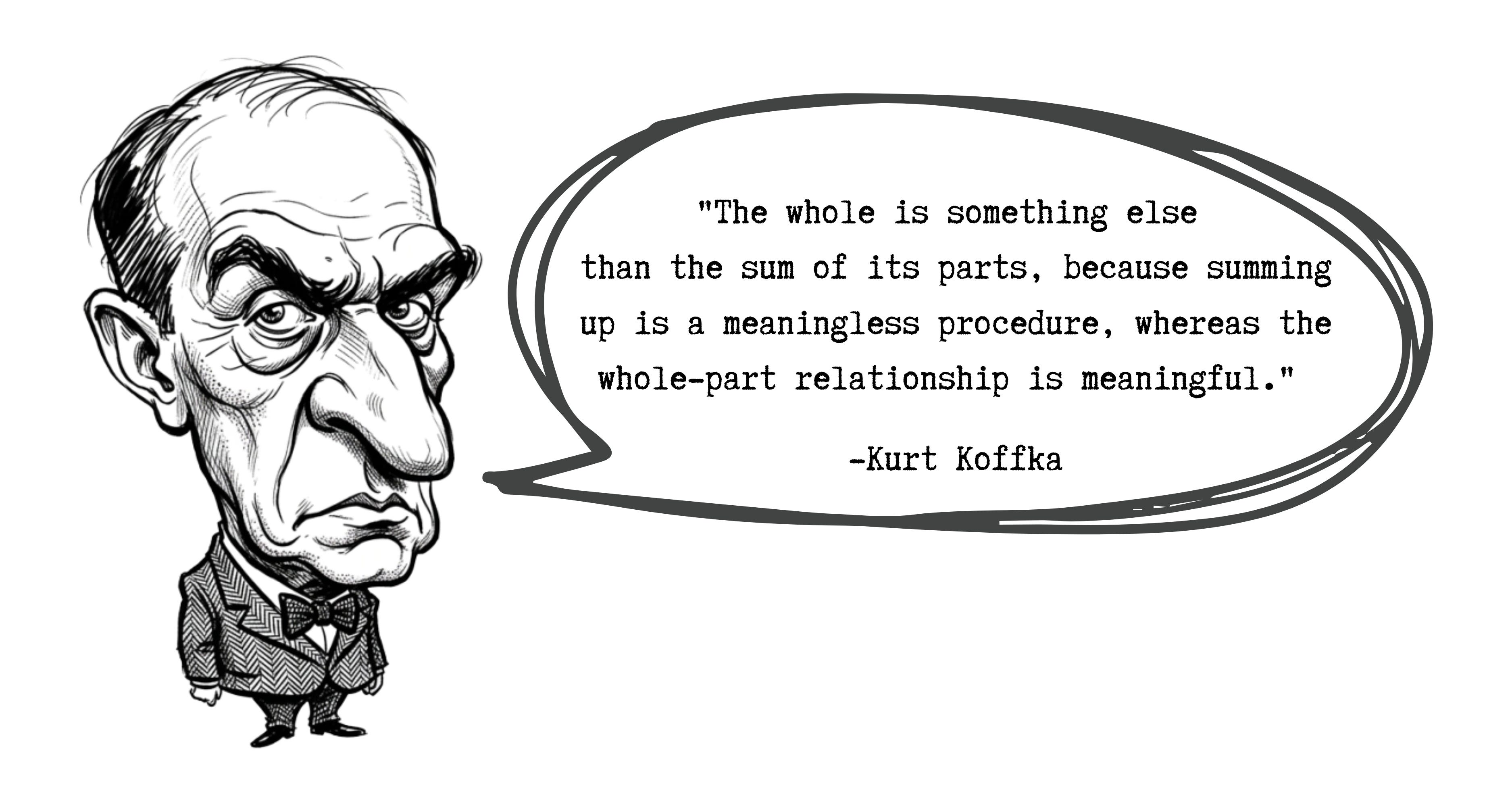
In German, gestalt means shape, form, or organized whole. Gestalt psychology is a school of psychology and a theory of perception that proposes that humans perceive patterns and configurations as integrated wholes rather than as collections of separate parts.
Proposing a Processing Propensity Within the HNP Framework
Now, I am not proposing that all HNP-profile individuals are gestalt language processors. That would simply relocate the same categorical error the field is already stuck in. I rather propose that HNP describes a regulatory phenotype and tendency toward elevated, lifelong plasticity and latent cross-system coupling. Its expression varies by developmental history, by regulatory load, by whether that coupling capacity is active or dormant at a given time. So here is what I’m actually proposing: the tendency toward meaning-driven, whole-pattern integration that characterizes HNP systems creates conditions favorable to gestalt-style language acquisition. Some HNP-profile individuals will show a strong GLP tendency. Others will move fluidly between gestalt and analytic processing. Some, depending on how their development unfolded, may show very little gestalt tendency at all.
The framework predicts elevated probability across this population, with the same variance that shows up everywhere else in HNP.
Predictive Processing as a Mechanistic Bridge
HNP already draws heavily from predictive processing models of the brain. These models propose that brains continuously generate predictions about the world and update those predictions against incoming information. The information isn’t weighted evenly. Signals that are emotionally relevant, coherent, and biologically meaningful tend to exert more influence over what gets encoded and retained.
This helps explain why gestalts might form in some nervous systems. A gestalt is an information-rich package: meaning, emotion, context, and prosody, bundled together. An HNP-profile system may preferentially stabilize around that bundle before it ever decomposes the bundle into smaller parts. Lawson and colleagues (2014) have already proposed something similar for autistic perception generally: that incoming signal gets weighted atypically against prior expectation. Gestalt acquisition may be that same dynamic, showing up specifically in language.
Language arrives whole, in other words, because for some systems the whole carries more reliable signal than its unresolved pieces do.
The Body is Part of the Whole
HNP doesn’t stop at the cognitive level. The coupling that defines the framework runs into the body too. Signals from the autonomic, immune, and connective-tissue domains can carry amplified influence on interoceptive experience in HNP-profile systems. That influence is present during language learning, not separate from it. Take a phrase that arrives alongside a strong bodily state such as fear or delight. The state may be part of what made the phrase stick, rather than a separate emotional layer added after the fact.
Emotional memory research already tells us that emotionally salient experiences get preferentially consolidated into long-term memory, through the amygdala, the hippocampus, and broader salience networks. That’s established, and it isn’t mine. My addition is about where the amplification comes from in HNP systems specifically: cross-system coupling, where the body’s signal is doing real work in what language becomes a durable, whole unit.
I haven’t seen this particular mechanism laid out before. If it holds up, the GLP field gets something it currently lacks on either side of the debate: a testable account of why gestalts form.
Prosody, and the Question of Segmentation
Haydock and colleagues (2024) note that gestalts come back out exactly as they went in, with the same pacing, intonation, and affect. They also propose that the gestalts that carry the most emotional weight are the ones most likely to be retained and eventually recombined into flexible language.
Prosody fits this picture naturally. It’s rhythm and breath before it’s anything linguistic, which makes it a good carrier for the bodily signal described above. The words themselves may almost be incidental. What’s really getting encoded is the whole bundle, held together by tone.
This seems to point towards something the GLP literature has struggled with. Flagging it as a hard problem, Prizant also wondered how segmentation eventually happens. Word boundaries aren’t marked in running speech, and reduced sensitivity to prosodic cues may itself be part of autistic processing. My guess, within the HNP framework, is that segmentation depends on regulatory stability rather than fixed ability. As load decreases and the system settles, it may stop needing the whole as its anchor, and the parts become available. I’d call that a working hypothesis with a mechanism attached, nothing more.
What I know from lived experience is that load decreases, or in certain settings such as with clients, I rely less on gestalts. Put me in a more personal or emotionally charged relational space, and I NEED them to communicate well.
Across the Wider (and Wilder?) Neurodivergent Landscape
GLP research has focused almost entirely on autism. However, not all gestalt processors are autistic, and not all autistic people are gestalt processors. The pattern doesn’t sit neatly inside one diagnostic category, which is itself a clue that something broader is at work here.
Gifted neurodivergent people often show the same meaning-first profile: understanding arriving before the ability to demonstrate it step by step. That declarative/procedural asymmetry is already well documented in the giftedness literature, with no reference to GLP at all. Twice-exceptional individuals frequently show a related pattern in language, where sophisticated, metaphor-rich speech sits beside surprising gaps in sequential decoding. From outside, that may look inconsistent. From inside an HNP lens, it’s a gestalt-leaning neurotendency operating in a system also carrying procedural and regulatory load.
ADHD is a harder case, and I’d rather say so than smooth it over. Its salience-driven attention raises a real possibility that emotionally charged language gets encoded preferentially over sequential instruction. Whether that’s GLP-adjacent or something else entirely, I don’t know. It needs its own study.
Across all of these populations, the claim isn’t that everyone is a gestalt processor. It’s that a shared neurotendency toward meaning-first, body-coupled integration raises the odds of GLP-style expression wherever it shows up, shaped by each person’s own development and current state.
The Research Question and Future Endeavors
Here is the question this whole piece is building toward: Do HNP-profile individuals show elevated tendency toward gestalt-style language acquisition, and how might regulatory load and attunement shape that expression across development?
Some of what follows from it is testable now, with tools that already exist. Do HNP-profile individuals retain emotionally and prosodically salient language better than affectively neutral language, beyond what ordinary emotional memory would predict? Do heart rate variability, electrodermal activity, or breath synchrony during language exposure predict later retention of gestalts? Does regulatory stability over development predict when segmentation happens, separate from age?
If any of it holds, co-regulation during language exposure stops being a general support and becomes part of the mechanism itself.
Oh.
The field has spent its energy arguing over whether to validate GLP as a category. I’d rather ask what a gestalt actually is. HNP offers an answer: a coherent, body-coupled unit that a meaning-first nervous system settles around before it ever resolves the parts. This doesn’t settle the debate. I’m just trying to give it firmer ground to stand on while the real empirical work gets done.
Yes—I enjoyed reading this Patty!
My question with regards to its opposite: the top down language acquisition conventional model… how do people divorce themselves from the whole-body package of information that each word carries?
I find that fascinating.
For me, life is a sensory bath of patterns and my body is organising it, continuously. There is depth and breadth. It’s not what it said; it’s what was not said, vocal tone and timing; to who, and for what reason… so much information carried in words.
My body is aware of this, and I wonder what it would be like to perceive only words.
Hi Dr. Gently! Really good, especially at keeping the fires going about understanding our differences and appreciating them, instead of pathologizing.
I have been working hard at trying to understand more completely the common denominator (or major variable) in the creation of many of the sensitivities and challenges (and huge upsides) that have been identified as part of the ASD picture. I have focused in on looking at how powerful the combination of general sensory amplification (locus coeruleus major influencer) PLUS data conflict sensitivity (high gain anterior cingulate cortex) could be understood as amping up pattern and dispattern recognition like no other hardware around. BTW, I do not talk much in the usual doc-speak.
I wonder if you would consider taking a look at three of my recent posts about sensory sensitivity, data conflict monitoring and one titled “Wouldn’t it be nice if hypocrisy made people sick. Guess what? It does, but not for enough of us.” Let me know your thoughts . . . or, just a thumbs up or down, if time constraints are at play.
Kudos for your work on these things. Understanding, I think, should lead to appreciation and ditching the term disability for the term vulnerability and ability for hardware default settings that were and are hugely valuable. That also might require changing the rule of gold to the golden rule.. . hmmm